Map of Oldest Civilizations in the World

About Oldest Civilization in the World
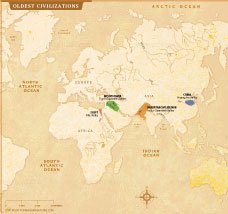
This historical map illustrates the world’s oldest civilizations that shaped human history. It highlights four major ancient cultures: Mesopotamia in the Tigris-Euphrates Valley, Egypt along the Nile River, the Harappan Civilization in the Indus-Saraswati Valley, and China’s Huang Ho (Yellow River) Valley Civilization. These river-based societies were the birthplaces of agriculture, writing, trade, and governance. The map provides a clear geographical perspective, showing how fertile valleys and water sources supported early settlements and cultural growth. Ideal for students, educators, and history enthusiasts, this map visually connects the origins of civilization across Asia and Africa.
The Mesopotamian Civilization (c. 3500 BCE–539 BCE) developed between the Tigris and Euphrates Rivers, often called the “Cradle of Civilization” for pioneering writing, law, and agriculture. The Egyptian Civilization (c. 3100 BCE–30 BCE) flourished along the Nile Valley, known for its monumental architecture, hieroglyphic writing, and organized governance under powerful pharaohs. The Harappan or Indus Valley Civilization (c. 2600 BCE–1900 BCE), located in the Indus-Saraswati basin, showcased advanced urban planning, drainage systems, and trade networks. In East Asia, the Chinese Civilization (c. 2000 BCE onward) began along the Huang Ho (Yellow River), laying the foundation for Chinese culture, technology, and philosophy. Together, these early civilizations shaped the course of human history through innovation, cultural development, and lasting contributions to art, science, and governance.